



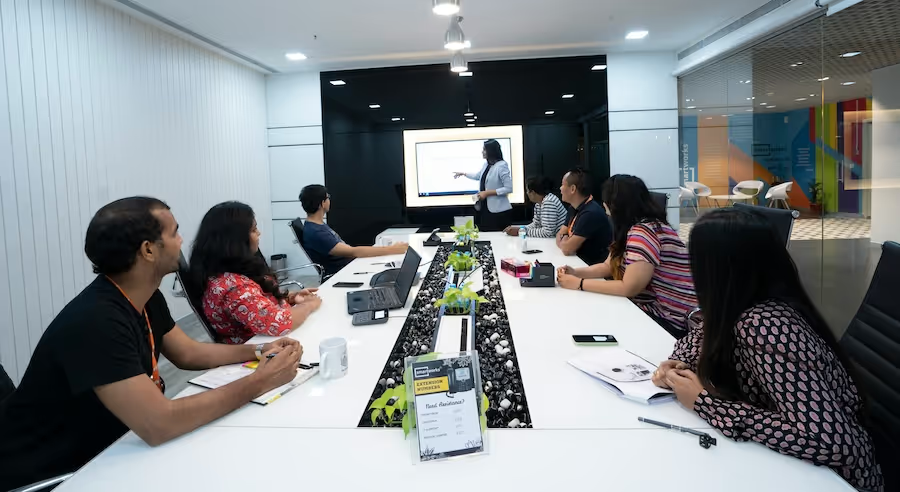
Finding Your Work Rhythm Without Burning Out
In a world driven by productivity, finding your own work rhythm can help you stay effective without exhausting yourself.
Learn more

See how our solution helps HR leaders boost engagement and reduce absenteeism.

Some of the stress we experience comes from negative emotions that we feel unable to control.
But what about the feelings we can genuinely influence?
According to research in positive psychology, the share of happiness we can influence is estimated to account for 40% of our well-being.
External factors account for 10% of our happiness and are often linked to our living conditions. The same research also points to genetic factors, which account for 50% of our happiness.
What about the remaining 40%?
Positive psychology aims to understand the secrets of optimistic people. In this article, psychologist Clémence Ruelle discusses the positive attitudes we can all cultivate to improve our own happiness.
Start with what Clémence Ruelle calls “the three good things”.
Name three things that make you feel good and bring you positive emotions.
List three things you do every day that contribute to your well-being: watching a sunset, having breakfast with your child, and so on.
These things do not require a major commitment from you.
So ask yourself: have you had your three good things today?
The first lever that can significantly increase your tendency towards happiness is gratitude.
What do we mean by gratitude?
Gratitude means appreciating the things we have and never taking anything for granted. Ultimately, it means being satisfied with little, which is often a powerful antidote to negative emotions.
Gratitude helps us feel happier because it has several positive effects on our well-being.
For Martin Seligman, the father of positive psychology, optimism means seeing the future in a more favorable light and believing that the future will be more promising than the present.
It is not about forcing ourselves to think positively, but rather about cultivating a particular way of seeing things.
Optimism is a personal interpretation of the events that happen to us. It is less about victory, failure, or success than about causality.
Optimism affects our thoughts, which affect our emotions: what do I attribute my victories, successes, and failures to? Was it luck or pure chance?
Optimists tend to see the bright side and take ownership of their successes, while pessimists are more likely to attribute them to chance.
The good news is that optimism can be developed!
We can influence our tendency to view success or failure as the result of internal or external factors. Although we each have a greater or lesser tendency towards optimism from birth, we can use techniques to strengthen our ability to remain optimistic despite the ups and downs of everyday life.
Open the teale app to discover our activities designed to strengthen this natural asset :)
We have reviewed the benefits of gratitude and optimism.
Let us now consider another benefit that is just as important for our balance: the power of the present moment.
In everyday life, we spend most of our time thinking about yesterday and tomorrow. Yet grounding ourselves in the present is essential for protecting positive emotions.
It is exhausting for the mind to anticipate what might go wrong tomorrow or regret what went wrong yesterday. To avoid draining our resources, we can strengthen our ability to live in the present.
This is one of the principles of mindfulness meditation, which considers that we can train our minds to develop more positive emotions.
Try to live fully in the present moment. Why is this so important?
Positive psychology is not a magical or unrealistic world. On the contrary, it is an approach that seeks to understand why some of us feel well.
Research now tells us that well-being is ultimately a balance between positive and negative emotions. To support our well-being, we can therefore see gratitude and optimism as a first step towards calmer emotions.
Mental health is like physical health: take care of it ;)
Key takeaways 💡
See how our solution helps HR leaders boost engagement and reduce absenteeism.
Ask an AI agent to summarize, deepen, or rephrase this article. The prompt is pre-filled with the URL of the page.