




Workplace Mental Health: 5 Arguments to Convince Your Executive Committee
As an HR leader, you’re convinced that mental health policies are essential. Now it’s time to persuade your executive team. Here are five key arguments.
Learn more

See how our solution helps HR leaders boost engagement and reduce absenteeism.
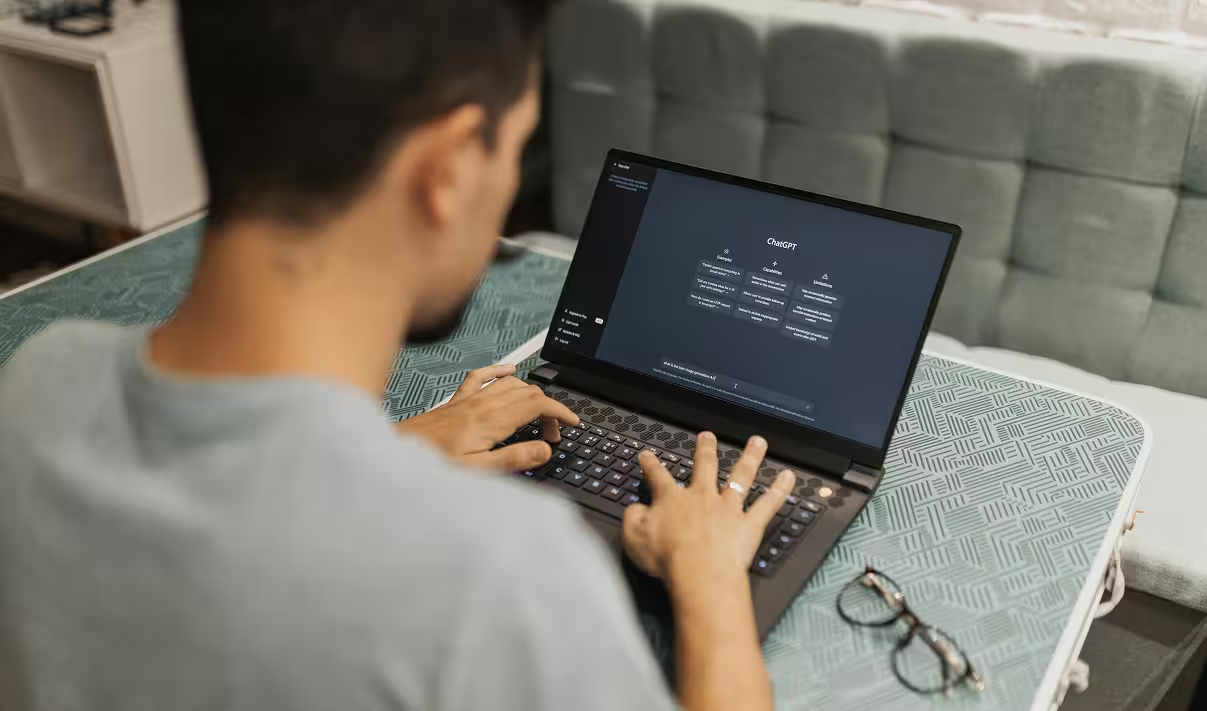
Generative artificial intelligence (AI) is now one of the most powerful drivers transforming our working environments. While its promises of productivity and automation are widely documented, its impact on workers’ psychological balance has so far remained largely unexplored.
To shed light on these issues, teale, a leading workplace mental health prevention platform, joined forces with Dr Justine Massu, a researcher in organisational psychology, and the innovation studio Tomorrow Theory. Together, they launched this first barometer dedicated to the links between AI and mental health, giving organisations practical guidance for reconciling technological innovation with psychological well-being.
[hook1]
The barometer is based on a rigorous survey conducted between July and September 2025 among 1,956 respondents working in France, representing the active French population.
The study notably uses the WHO-5, a standardised indicator developed by the World Health Organization, to assess employees’ overall psychological well-being over a given period. The objective is clear: to understand whether generative AI acts as a driver of fulfilment or a source of vulnerability.
The barometer’s first finding challenges the idea of the massive and immediate adoption often portrayed in the media. Although generative AI is highly visible in public debate, its practical use remains uneven.
[hook2]
Generative AI does not simply perform tasks. It profoundly changes how employees perceive their work. The study highlights a central “psychological triad”:
The heart of the study concerns psychological well-being. Contrary to fears about technostress or dehumanisation, the short-term figures are broadly positive.
Although the current data are encouraging, the barometer’s authors warn of latent effects of generative AI use at work that may only appear over time.
The final conclusion of the barometer by teale, Tomorrow Theory and Dr Justine Massu is that generative AI is not inherently a source of well-being or ill-being. It acts as an amplifier. It strengthens positive dynamics where use is well understood and supported, but weakens organisations where it creates loss of meaning or identity insecurity.
Three action levers emerge for companies:
Generative AI can be a genuine lever for fulfilment if it is treated as support, not as a substitute for human intelligence and sensitivity. This is the condition for technological transformation to become a sustainable mental health lever.
Discover our five strategic levers for turning AI into an ally of your company culture in our second article about the barometer published by teale, Tomorrow Theory and Dr Justine Massu.
At this stage, teale’s AI and Mental Health Barometer finds that artificial intelligence is not a collective driver of deteriorating workplace mental health. Well-being indicators remain broadly stable.
According to teale’s AI and Mental Health Barometer, using AI at work strengthens perceived self-efficacy by helping people achieve results more quickly. However, the study shows that negative perceptions, such as fear of being downgraded, are concentrated among occasional users. For them, AI is perceived as a competitor to their expertise, whereas regular users integrate it as support that strengthens their own sense of competence.
Using AI at work reduces immediate irritants and the mental load associated with repetitive tasks. However, if automation is not followed by reinvesting the time saved in meaningful work, it can conceal an erosion of the employee’s genuine usefulness. Surface-level technical comfort can therefore coexist with a deeper existential void.
.svg)
SAMPLE
This barometer is based on a rigorous survey conducted between July and September 2025 among 1,956 respondents working in France, representing the French working population.
.svg)
HOW OFTEN EMPLOYEES USE AI
12.4% use it several times a day, 25.7% several times a week, and 37% several times a month.
See how our solution helps HR leaders boost engagement and reduce absenteeism.
Ask an AI agent to summarize, deepen, or rephrase this article. The prompt is pre-filled with the URL of the page.